Wednesday, March 08, 2006

McConnell to review methadone policy

From the Herald:
"A review of the use of methadone in drug rehabilitation programmes was announced by the first minister yesterday, after a child's death prompted wider questions about the heroin substitute which costs £13m a year."
I wise move, I think most healthcare and social work professionals in Scotland agree. The evidence has been growing for some time thatmethadonee essentially functions socially as merely one amongst a cocktail of drugs that former heroin-addicts use to stablise their addictions.

Horrific as this case was, the Executive would be wise to resist any pressure from the moral panic that seems to be coming from a number of quarters. Most people agree that methadone is to the world of addiction what prozac was to mental health; touted originally as the cure-all wonder-drug, until it's widespread prescription collided with reality. But it remains the case that the methadone programme has, in terms of fatalities, produced roughly a 50% harm-reduction in Scotland.

And remember that it is in the nature of this kind of case that can cause people to forget that sometimes there's a simple solution to avoiding tragedies of this nature: make them drink it in the chemist, for goodness sake! Don't let people take this stuff home.

Monday, March 06, 2006

'Toons and terrorism news

The Australian carries a study that shows to date that 56 countries have published the cartoons of Mohammed:
"CARTOONS of Prophet Mohammed, that were first published in a Danish newspaper last year and sparked an outcry in the Muslim world, have been reprinted in 143 newspapers in 56 countries, a study shows.

One or several of the 12 controversial cartoons have appeared either in print editions or online, according to the study done by eJour, the online magazine of the Danish School of Journalism.

Most of the reproductions have appeared in Western countries, including 70 newspapers in Europe, 14 in the United States, three in Canada and New Zealand, two in Australia and one in Japan.

But the drawings have also been printed in eight Muslim countries: Algeria, Bosnia-Hercegovina, Egypt, Indonesia, Jordan, Malaysia, Morocco and Saudi Arabia.

In the United States, no national newspaper has published the cartoons, but 14 regional and local publications have, according to the study conducted in February."
Britain is not mentioned in the study for obvious reasons.

Via Freedom for Egyptians.

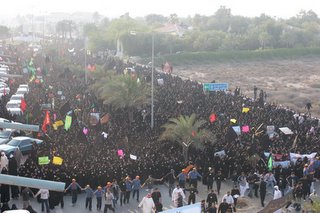
The 'Arab Street' was up in arms again - in Bahrain there was a massive demonstration against terrorism.

The story and more pictures are here.

Via Sandmonkey.

Against homogenization.

Scottish Parliament producing excessive hot air

In this country even our buildings descend into self-parody.

Taking potshots at the powerless

Gary Younge in today's Guardian retreds a well-worn theme from the anti war, pro-self-censorship lobby and mixes with it the now all-too familiar disagnosis of moral failure for those who take the contrary view:

"What, after all, is 'brave' about supporting the policies of both your government and the sole global superpower against a country that posed no threat? (...) To align yourself with the powerful and then take aim at the powerless takes not one ounce of valour. To prop up prevailing hierarchies and orthodoxies rather than challenge them demands not a scintilla of bravery."
I was going to give this a more charitable treatment because towards the beginning, there are some reasonable points about people being racist, sexist or whatever and then claiming bravery in the face of a censorious politically-correct establishment. But then when I read and understood that he believes the context in which speech is exercised to be crucial, the old red-mist begins to descend.

On his question, I can say on my part, none at all. Really doesn't require courage for me to take the position I did as a minority of one against ten in a pub on a Friday with other fellow-professionals, some of whom have authority over me - because I'm not afraid of any of them. Although I should stress that this isn't because I actually expected the boys from the Pentagon to come and assist me. And Mr Younge might also want to consider that not everyone is as indifferent to the prospect of promotion as I am.

Yes, the context is everything, as this trivial example illustrates. And the very triviality of it exposes Mr Younge's failure to give context its due. His is a rather simple world divided up between the imperialists and their apologists and the oppressed and their champions - he's the latter; if you disagree with him, that's because you're one of the former - and that's that.

But let us consider this context: you 'collaborate' with the imperialist occupier because you believe even the faint possibility that a secular liberal democracy may be established represents a better prospect for Iraq than anything on offer from the schism-perpetuating Jihadists, the ex-Ba'athists and the ultra-nationalists that dominate the insurgency. You didn't support the war yet you are willing to risk your own saftey by taking this chance. For this you are brutally-murdered, probably by ex-Ba'athists. In the West, those who you might have expected to defend your corner, those who wear their solidarity with the world's oppressed on their sleeves, don't say anything. Not a damn thing. Rather, they find something 'understandable' in the motivations of the fascists who cut your throat like a pig.

Younge's lazy use of leftish-sounding but conveniently-ambiguous phrases is absolutely infuriating. I mean, I understand I'm supposed to think "prevailing hierarchies" are a Bad Thing but which ones is he talking about? Doesn't the reign of Saddam Hussein count? And doesn't the view that rejected his ouster on the grounds of 'stability' count as an "orthodoxy"?

I dare say the editor of Jyllands-Posten "had illustrated not just an insensitive Islamophobic jibe but a racist mindset that has consequences for Muslims worldwide" - although unlike some, I don't claim to know his mind. But does anyone now doubt that to publish cartoons that might be for Mr Younge satire of an acceptable, non-racist nature, really would require some courage? But I suspect for people like Mr Younge, the notion of an acceptable satire of Islam is inconceivable and I really think he and others who share his view should start asking themselves why that is. Because at present, their advocacy of self-censorship in the name of protecting the powerless is looking increasingly threadbare. Oh, and while we're on the subject, how much courage does it take to accuse everyone who disagrees with you on the subject of Iraq, the Middle East, Islam and bloody Danish cartoons of being racist? I'm thinking probably not much - and it certainly doesn't seem to require much effort. Or are they just making it look easy?

The notions of courage and cowardice have been used and abused in this whole debate. But can we dispense with the idea that it requires "courage" to batter out our "controversial" opinions behind a keyboard? But the notion of power, political and economic, and how it operates in different contexts I'll stick with. Gary Younge sits behind his keyboard and tells us what he thinks, he gets lots of emails and letters to the editor, some disagreeing, some agreeing, some sychophantic, a smattering from the vicious and the insane, and then his employers give him some money. I sit behind my keyboard and do the same, don't get much mail, what with the ever so slightly-lower circulation, do it for free because if my employer finds out what I'm doing, I'll get my ass kicked.

It's all relative - but in this inconsequential context it looks to me like Mr Younge's the one with the most power between us. That's why I thought he might not mind if I took a potshot. After all, cuddly though it is, the Guardian is one of those evil business thingys, isn't it? And anyone who works for this one whilst simultaneously presenting themselves as the enemy of "orthodoxies" really does have a bit of a nerve, especially these days.

Early exams may harm learning

From the Herald:
"Curriculum chiefs yesterday attacked the growing trend of letting Scottish pupils sit their exams a year early.

Officials in charge of the widest-ranging review of Scotland's school subjects for decades warned that widespread use of so-called "early presentation" could damage pupils' learning."
Should probably file this under "no shit, Sherlock" and be done with it but it highlights a problem in both Scottish and English education that could be doing with highlighted, given the number of people who sincerely believe all our educational problems will go away if we "set our schools free" to act like supermarkets. The article refers to the growing practice of having kids in secondary schools sit our equivalent of GCSEs, the Standard Grade, earlier:
"The idea is to provide a greater challenge in the early years of secondary schools after inspectors warned that many pupils switched off in S1 and S2 because of a lack of motivation."
Translation: by about October, your S1 class is slowly and surely losing its collective marbles and by S2, it has developed into full-blown insanity. Let's get the little blighters doing Standard Grades a year early; that'll calm them down.

But it's not going to work because it's a mistaken diagnosis: there is not too little formal assessment in British schools; there is far too much. The relationship between educational standards and assessment would tend to suggest the opposite, if anything.

I think just about all of our European friends have less of this and have what are generally considered to have better education systems and it is common practice in private schools to dispense with the Standard Grade altogether, leaving the first external exams until 17. Why do they do this? Because it "sets them free", as it were, to develop a curriculum that is geared towards learning stuff, rather than passing exams. How about setting schools free by getting rid of all this bloody assessment? Internal, external, continuous, remorseless, tedious and stressful for everyone concerned and to what end?

Wouldn't it be easier simply to make S1 and S2 courses less crap? Currently, they tend to get neglected because we have a whole exam-worshipping culture and the low priority given to non-certificate classes is palpable at almost every level. Department heads sometimes like to exercise their authority by taking the classes they think are most important.

Unsurprisingly, this almost never involves taking on S1-2 in any serious way. These tend to get bundled onto students, supply teachers and new starts. I've got an idea: instead of Head Teachers saying they're taking the issue seriously by foisting an ever-growing diet of exams on pupils, why don't they get the finger out, realise the "Learning Community" they are supposed to be running can do without their Powerpoint presentations, thank you very much, and take a few classes themselves? Just a thought.

Blog Archive